
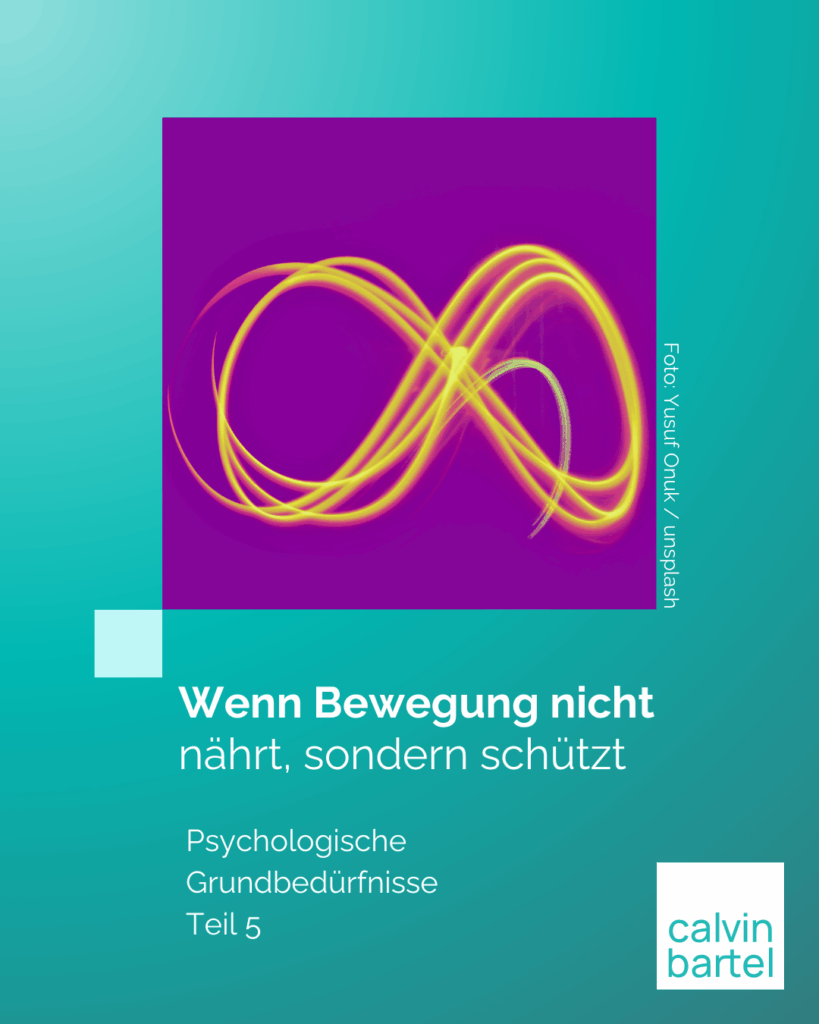
When Movement Doesn’t Nourish but Protects
Some inner movements are, in truth, well-disguised avoidance. What does that mean?
So far, I’ve described the fluidity between the poles of core needs as essential for psychological well-being, as an expression of inner vitality and self-contact.
But sometimes we don’t flow. We move in stagnant circles.
Like a figure eight:
> Toward the need. But only to the point where pain arises. < Then the retreat. Seemingly toward the opposite pole, actually toward safety. > And then back toward the need again. Not from longing, but from deprivation.
What looks like rhythm is really more of an evasion, away from disappointment, old wounds, vulnerability.
Typical sentences from coaching:
“I need closeness. But somehow it always gets to be too much.” “I enjoy freedom. But then emptiness comes, so I look for connection again.” “I want to show myself. And when it gets serious, the moment just doesn’t feel right.”
That sounds relatable, and it’s often honest too. But it’s not always the expression of a need.
Often the movement begins with a cautious approach: we allow ourselves to acknowledge a need and feel the desire. But the moment the need becomes concrete, something stirs in us, an irritation, an alarm, a vague form of discomfort.
Instead of continuing, we stop. Not always consciously, often as if on autopilot. The direction reverses.
Away from the need, toward relief.
But what looks like a shift to the other pole is often an interruption of contact: not a genuine decision for or against, but a protective reflex.
The result is a back and forth that simulates movement but never establishes contact. The need remains at a distance. Not because it isn’t there, but because experiencing it is linked to too much uncertainty.
How do you recognize the difference?
Movement from contact: ~ I feel myself, even as I change. ~ I express what I want, without justifying myself. ~ There is an inner ground from which I choose.
Movement from avoidance: ~ I move. But without having arrived. ~ I withdraw. Without having felt. ~ I switch. But without choosing.
A lived need tends to feel soft, breathing, rhythmic.
Avoidance tends to feel rigid, tight, controlling. One nourishes. The other protects.
Some movements feel alive, but they only lead us in circles. When we learn to sense the difference, a space opens for genuine moments of contact. For what we truly need, and for an experience that no longer has to flee.